


Contents of this blog
Every building in Belgium with more than one flat owner is legally required to have a co-owners' association (also called VME in Dutch or ACP in French). On this page, we look at the steps you take to set up a VME for your building.
VME definition
VME literally means vereniging van mede-eigenaars, which is Dutch for "co-owners' association". In the context of Belgium, a VME is a legal entity that is automatically created when a building or group of buildings has multiple owners. The VME unites all individual co-owners, manages the common areas and protects the interests of all owners.
Step 1: Establishment
In Flanders, an co-owners' association is automatically established as soon as a building has more than one owner. As a co-owner, the actual “establishment” of the co-owners' association or VME is therefore the easiest step, as it takes a lot of work off your hands!
The articles of association
When the building is completed, two important documents should already be in place: the basic deed and the co-ownership regulations. Together, these documents form the articles of association of the VME. As a syndic or co-owner, it is important to know what is described in them.
1: The basic deed
The basic deed is the legal foundation for the operation of the VME. This document describes how the building is divided: the units, the common areas, etc., and how the VME divides costs and charges.
2: The co-ownership regulations
These regulations contain the rules and regulations for daily life within the VME. They lay down matters such as the use of common areas, but also the rights and obligations of the residents and how decisions are made.
Step 2: the syndic and the first general assembly
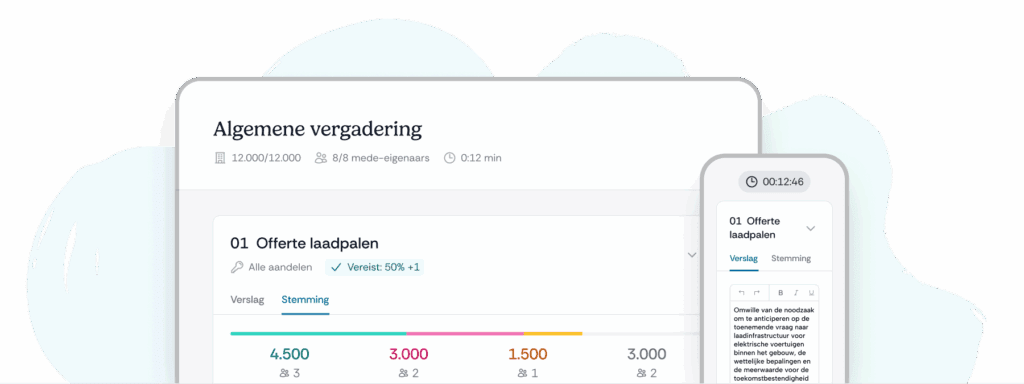
The first general assembly
The first general assembly is a crucial moment for your VME. During this meeting, the basic principles of management and cohabitation in the building are established. You must discuss the following matters:
- Approval of the internal rules of procedure: This draft is drawn up by the VME or the syndic and discussed and approved or amended during the first assembly. It must be in accordance with the building's basic deed. Please note: do not confuse this document with the co-ownership regulations!
- Starting up and managing the financial resources of the VME: See step 3.
- Establishment of the co-ownership council: This body is only mandatory when there are more than 20 units (excluding cellars, garages and parking spaces).
- Appointment of a syndic: If a temporary syndic was appointed upon delivery, their mandate ends at the start of the first general meeting. During this meeting, the co-owners elect a (new) syndic who will take on the management of the VME for the coming term.
Registering the syndic
As discussed above, the VME elects a new syndic during the first general meeting. It is important to compare the differences between a professional syndic and an owner-syndic and decide which of the two suits your VME best.
Important: Since 2017, VME's have been required to register their syndic with the Crossroads Bank for Entreprises (CBE) for transparency reasons. Don't forget to do this on time – no later than the working day before the syndic starts. If the syndic is appointed less than eight working days before the start, registration must take place within eight working days of the appointment.
Looking up your company number
After registering your VME and syndic with the Crossroads Bank for Enterprises (CBE), your VME will receive a unique company number, also known as the CBE-number. This number is essential for various administrative matters and communication with government agencies.
You can easily look up the number using the CBE's public search function:
- First go to the CBE search page.
- Enter the name of your VME or the address of the building.
- Click on “Search” to find your VME's details, including its company number.
Step 3: Setting up the financial management
Good financial management is essential for the functioning of the VME. That is why the syndic opens a bank account in the name of the VME to manage the common funds. Co-owners pay their contributions into this account to cover future expenses of the VME.
Working & reserve capital
There are two mandatory bank accounts for your VME:
-
Working capital: This account is like a current account and is for everyday expenses like maintenance and utilities.
- The working capital is replenished with monthly or quarterly (depending on the articles of association) advances from the co-owners. In the annual budget, the surplus is repaid or the deficit is replenished.
-
Reserve capital: This account is similar to a savings account and is for larger, less frequent expenses such as major maintenance or replacements (e.g. a new roof or lift). There must be a minimum amount in the reserve fund, which depends on the number of units and the estimated costs.
- Contributions to the reserve fund are made monthly, quarterly or annually. On an annual basis, they may not amount to less than 5% of the total expenditure of the previous financial year.
Budget and accounting
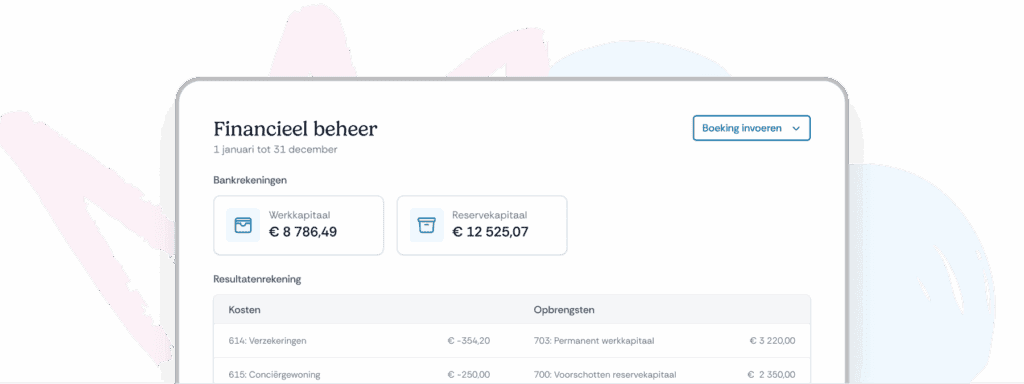
Draw up a budget for the coming year that covers all expected income and expenditure. Transparent accounting is necessary to keep the financial situation of the VME clear and understandable for all residents.
Step 4: Insurance, documentation and communication
Insurance
The only compulsory insurance is the syndic's liability insurancein case of an owner-syndic, the VME pays for this assurance. In addition, depending on the articles of association, you usually also have to take out compulsory building insurance (fire insurance for the whole building). Even if this insurance is not compulsory, it is strongly recommended that you consider taking it out.
Documentation
As a syndic, ensure that all important documents are stored securely. These include the basic deed, the co-ownership regulations, and the notes from the general assembly. These documents are important and must therefore be accessible to all co-owners.
Communication
Good communication between the syndic and the co-owners is essential. Keep all owners informed of important matters such as financial updates, work being carried out, and other relevant information. This helps to prevent misunderstandings and ensures that everything runs smoothly.

Start with better management today
- Better ambiance in your building
- Lower costs
- No missed subsidies
- Everyone stays up-to-date